Showing posts with label Fine Motor Skills. Show all posts

Thursday, October 24, 2013

Lots of Pumpkins!

Last week I went to Sprouts Farmers Market to get a couple of pumpkins for our classroom. They were so cheap I ended up getting about twenty pumpkins and gourds in all different sizes and colors. Since then, we have been using them in all areas of the classroom and even in the playground. Here are some of our favorite ways to use pumpkins at preschool.

1. Pumpkin Hammering


We hammered golf tees into one of the bigger pumpkins with the hammers from our work bench. Holding the tee still with one hand while hitting it with the hammer requires concentration and works fine motor skills and hand-eye coordination. 

2. Pumpkin Geo-Boards


This one was my co-teacher, Miss Erin's, idea. Once our pumpkin was full of nails, we stretched rubber bands around the nails to make shapes. 

3. Dry Erase Pumpkin Drawing


We drew faces that could wipe right off with our dry erase markers. 

4. Pumpkin Houses


We drew doors and windows on some of our pumpkins and added them, along with the little people, to the play-dough table.

5. Pumpkin Mummies


One of our class' favorite Halloween books is Skeleton Meets the Mommy. After reading it several times, we used gauze to make our pumpkins look like mummies.

6. Pumpkin Stew


 I saw this wonderful idea on the blog My Nearest and Dearest.


I simply set out the invitation to play and the children cooked up a delicious, pumpkin spice stew!

7. Pumpkin Painting


We dipped pumpkins and gourds in paint and rolled them across a big piece of paper. 

8.Pumpkins in the Playground


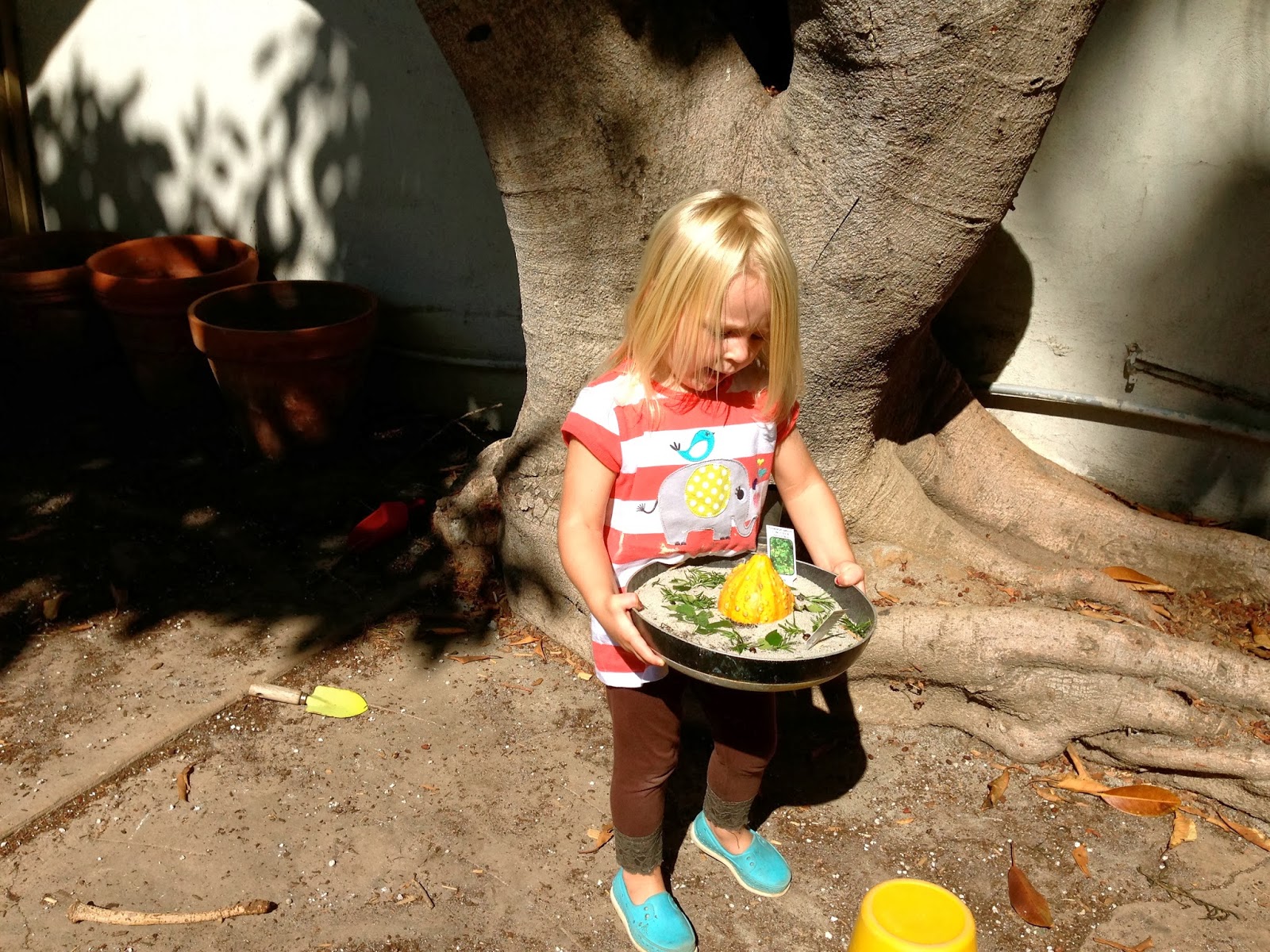
Sometimes it's best to just put out the materials and then let the children decide what to do with them. We took the pumpkins outside and added them to the other loose parts in the playground. Here are some of the wonderful and creative things we saw the children doing with them.



Tuesday, March 5, 2013

Marble Balancing

This is a great small muscle activity for toddlers and twos. It requires the children to use their fingers and thumbs in order to get the marbles balanced on the golf tees.
I stuck the golf tees into a block of styrofoam so that they were perfectly upright.
Once the children mastered the skill of balancing the marbles, they took all the golf tees out and reinserted them into the styrofoam on their own.
This made balancing the marbles quite a bit trickier because many of the tees were now at an angle.


Thursday, December 13, 2012

Wrapping Presents in Preschool

Every year at Christmas time, I set up a present wrapping center in the classroom. Ripping tape, cutting, and folding paper are great small muscle activities for young children. Besides, it's lots of fun to wrap and open presents!
To set up, I fill the wrapping center with rectangles of wrapping paper,
bows,
scissors, tape,
an assortment of boxes,
and some small toys from around the room.
As children came to the center, I explained how to rip the tape and fold the paper around the boxes. After a little while, they can usually do the folding on their own, but the tape can be a bit more difficult (so be prepared to go through lots of it!)
Of course, opening the presents was the best part!
Even though they knew what would be inside, the children got so excited as they ripped the paper and opened the boxes!


Tuesday, October 16, 2012

Family Style Dining in Preschool: A How-To Guide


Transitioning to family style dining can be an intimidating task for many teachers. Its easy to imagine a free-for-all occurring when the children have direct access to the meal, or mounds of spilled food all over the floor. In order for family style dining to work, you have to be prepared and you will need lots of patience.

To begin, child-sized dishes and utensils are a must. If things are too big, the children will not be able to manipulate them. This will lead to lots of spilled food and both children and adults getting frustrated. Here are the bowls and serving utensils we are using now at Aspen Leaf Preschool. Everything is inexpensive (it's all form Ikea, actually). The silver pitchers are meant to be for frothing milk but they are the perfect size for preschoolers. Our serving bowls are food storage container minus the lids. They came in a pack of five and we usually use the middle-sized ones. The small serving utensils were in the children's section and are meant to be toys, but they are just perfect for serving food. They are even dishwasher safe!


 These are the dishes we use (they're also from Ikea).


I have the children help me put the food into the serving bowls. Usually I'll choose one or two children to help with this, and one or two others to set the table. At the beginning, I'll set a napkin at each seat and instruct the children to place one bowl or plate on top of each napkin.


Then one cup and one spoon or fork on each plate. Later, when they have gotten used to the process, they are able to set the dishes out without the napkins marking the spots.


We always wait for everyone to sit down before starting the meal. To pass the time while we wait for everyone to sit down, I ask the children to open their napkins and "set their places." A set place looks like the picture below.


Once everyone is at the table, we sing (about our hands):

 Open, shut them,
Open, shut them,
Give a little clap, clap, clap.
 Open, shut them,
Open, shut them,
Put them in your lap, lap, lap.
 
This helps to get everyone's attention, calm the children down, and let them know that the meal is about to start. Before passing the bowls around, I show the children how many of each food they should take. I do this by serving myself and narrating what I'm doing. For example I would take two scoops of cereal and say, "This is the cereal. I can take two scoops. One, two. Now I'm going to pass it."


If we are having toast or bagels, I will set out a bowl of jelly. The children take a scoop of jelly with the serving spoon and then spread it with their knives (whenever we use knives we talk about how to be careful with them. Even though they are only plastic, it is important for children to know how to be safe with them).


The hardest part about family style dining is allowing the children to pour their own drinks. Inevitably they are going to spill, and at the beginning they are going to spill every time. But practice makes perfect and after a week or so, everyone will being pouring pretty well. For the first couple of weeks, I will use two pitchers. One big and one small one. I'll fill the big one with milk or water and pour only little bits into the smaller pitcher at a time. The children then pour from the small one. This way they can pour all of it without over-flowing their cups.


Once they get used to pouring, I fill the small pitcher about half way and show them how to stop pouring before the cup over flows.The first time a child pours without spilling is a big deal and I always make sure to compliment him or her.


At the end of the meal, each child cleans up his or her own place. We have a nice big sink in the classroom for all the dirty dishes, while napkins and uneaten food are placed in the trash. Every day we talk about what goes in the trash and what goes in the sink. If you're not mindful, you'll end up losing all of your dishes to the garbage!


Make sure to always sit down with the class and demonstrate the kinds of behaviors you expect from them. In order for this to work, the teachers have to lead by example. So make sure to set a place for yourself! Once everyone gets used to family style dining, you will find that it is much easier than making plates for the children and serving them. It is also much more pleasant to sit at the table with the children and have a conversation than it is to stand over them refilling their plates and cups.

To read about the benefits of using family style dining, check out my earlier post Family Style Dining in Preschool: Why it's Important.


Monday, October 15, 2012

Family Style Dining in Preschool: Why It's Important

During the first few weeks of school, the children have been getting used to all of the new routines and expectations that are part of going to preschool. One of my favorite, and also one of the most important, routines we are establishing is family style dining.

What is Family Style Dining?

With family style dining, children are responsible for setting the table, helping to get snacks and meals ready, serving themselves at the table, and cleaning up when they are finished eating. At first this may seem like a lot to ask of preschool-aged children, but it is surprising how much young children are capable of and how much they enjoy being part of the entire meal experience. Of course the teachers are also there to help out and encourage whenever necessary.


The Benefits of Family Style Dining

When children participate in family stye dining, they learn:

- How to take turns as they pass the food around the table
-To share when they realize that everyone gets some of the food being served
-Table manners as they watch the teachers sitting properly, saying "please" and "thank you," passing the food, etc.
-Healthy eating habits when the teachers lead a discussion about the food they are eating
-Self-help skills as they take responsibility for their own food needs
-How to clean up after themselves

Family style dining also gives children the opportunity to practice important skills such as:

-Small motor skills when they scoop and pour
-Counting as they count out the appropriate number of crackers, apples, etc.
-One-to-one correspondence when they set the table 
-Conversation skills when everyone at the table talks about the food, what they did during the day, etc. 

When children participate in family style dining, they gain a sense of accomplishment as they realize that they can pour their own milk and scoop their own cereal. They gain self-confidence and become more independent when they are able to do these things on their own.

In my next blog post, I will explain and show how we do family style dining at Aspen Leaf Preschool.

Friday, October 12, 2012

Practicing Circles on the Map

This week my class has been very interested in sea animals, dolphins especially. One morning, one of the children noticed that there were pictures of dolphins on the world map that is hanging in the classroom.


I purchased this map last year and laminated it at my local Lakeshore Learning store (laminating is only 29 cents a foot there).
Since we have been working on our fine motor skills, I gave the children dry erase markers and asked them to circle all of the dolphins on the map. 


Everyone enjoyed this activity so much that we decided to also circle the whales, the sharks, and then all of the animals on the map!


When we were finished, our map looked like this. As you can see, there are lots of beautiful circles on it!

Sunday, January 15, 2012

Crocodiles


This craft is a fun way for children to work on their fine motor skills. 

Before beginning the activity, I cut out a crocodile shape for each of the children. 

Then I folded them and drew guidelines for cutting. 

The children in our class love to cut with scissors so they were eager to begin. Cutting on the guidelines required a good amount of hand-eye coordination. 

Some of the children just wanted to cut and went a little overboard, which was fine. I had a few extra crocodiles on hand in case they wanted to try again. 

 We glued on the eyes...

and drew faces. 

I love that they were all different!


Pin It