Showing posts with label Science. Show all posts

Monday, July 14, 2014

Cooking in the Outdoor Kitchen with Herbs and Sparkles


We use sand and water a lot in our outdoor sensory table. Last week I noticed that the children were collecting leaves and grass from the yard to add to the water in the table to make "soup". I decided to set up the sensory table on the porch, where there is more space for the children to work, and to add a few new sensory items that would expand the cooking experience.

I had just purchased a big supply of sparkles for the art cupboard that I thought would add an appealing visual element to the sensory experience. I mixed some sand with the sparkles to make them last longer and poured them into some empty spice containers. I also picked some fresh and fragrant herbs from the garden and put them in a basket near the sensory table along with bowls, pots, pans, and mixing spoons.


The sparkles were very popular and we had to refill a few times. I was really glad that I had decided to add sand to the sparkles, otherwise we would have gone through our entire supply. 


The children "cooked" lots of different things, but wedding cake and soup were the two most popular dishes today.


Tuesday, October 15, 2013

Some Halloween Ideas from the Two's Room

Here are some things we did last October in the two's classroom.

Pumpkin Science Center


We put out different pumpkins and gourds along with pumpkin seeds, magnifying glasses, bowls, and rulers for the children to explore. 


Pumpkin Predictions 

Each of the children chose one of the pumpkins from the science center. We measured and weighed each pumpkin and I wrote down how the children described their pumpkins. Then each child predicted what they thought would be inside the pumpkins before we cut them open. Some of the predictions we got were a dinosaur, another pumpkin, and candy. 


Of course once we cut the pumpkins open, we saw that there were seeds inside. Everyone helped to scoop out the sticky seeds. 


And we made a jack o' lantern.


Seed Collage

We saved the seeds from the pumpkins and used them to make pumpkin seed collages.


Halloween Sorting

I found these Halloween erasers at Target.  We had lots of fun sorting them and making patterns with them.


Halloween Costume Dress Up

I found lots of Halloween costumes at Goodwill earlier in the year.  We put them in the dramatic play area along with Halloween bags and we pretended to go trick-or-treating. 


Spider Webs

We opened a bag of fake spider webs and the class helped to hang them around the classroom and put plastic spiders on them. 


Candy Corn Sorting
As a treat, we all tasted some candy corn and talked about the different colors on the candy. Then we cut strips of white, yellow, and orange paper into squares and glued them onto a paper candy corn cut-out. 


 Besides being a sorting activity, this also used lots of small motor skills as the children cut and glued. 


Happy Halloween!


Friday, February 8, 2013

Some Plant Themed Ideas

Over the past couple of weeks we have been doing lots of plant-themed projects. Here are some of my favorites.

1. Silk Flowers in the Sensory Table

I filled our sensory table with potting soil, added some shovels and flowers pots, and let the children "plant" silk flowers.

2. Bottle Print Flowers

We used recycled plastic bottles to make flowers. Then we drew a little stem on each flower.

3. Sprouting Seeds

Each of the students put a seed in a ziplock bag with a damp paper towel. We hung the bags in the front window and watched them sprout!


4. Q-Tip Flowers

I had the children draw stems on a piece of construction paper. Then we used Q-tips to make tiny flowers at the top of each stem.

5. The Parts of a Plant

For this project, I cut out stems and leaves from green paper. I used pieces of brown pipe cleaner for the roots and real seeds for the seeds. I gave each child a set of plant parts and let them glue the parts onto a piece of paper. When they were finished, they drew a flower on their plant. As they worked, we talked about the names of all the different parts of the plant.

6. Gardening

You can always do some real gardening with children too. To read more about this, check out my post on gardening in preschool.


Wednesday, January 30, 2013

Gardening in Preschool

One of my favorite children's books about gardening is The Curious Garden by Peter Brown. The illustrations in this book are charming and beautiful. It tells the story of a little boy, Liam, who makes his city prettier by growing trees, flowers, and other plants. My classes have always enjoyed reading The Curious Garden. They especially like comparing the picture of the city before it had gardens to the picture of the city after Liam inspired everyone to grow things.

Since we were about to start beautifying our playground with gardens, it seemed to be the appropriate book to read. After reading it, we set out to plant gardens "just like the boy in the book", as one of our students put it.

Over the weekend, I had taken a trip to the local nursery to get some plants and potting soil. I also found some child-sized gardening tools, children's gardening gloves, and small watering cans. We already had some large terracotta pots that I moved into the outdoor kitchen area. Once we went outside, I let the children shovel dirt into (and out of) the pots for a while before we put the plants in.

The actual planting part didn't seem to interest the children very much, so I did most of it.


They all loved watering the plants, though. At this rate, these flowers and herbs will never be thirsty!

When we were finished, I let the children use the extra potting soil to fill small terra cota pots...

and plant other things.

They also used some of it to "cook" in the kitchen area.

Mud soup! Yum!


Tuesday, January 22, 2013

Water Play Board

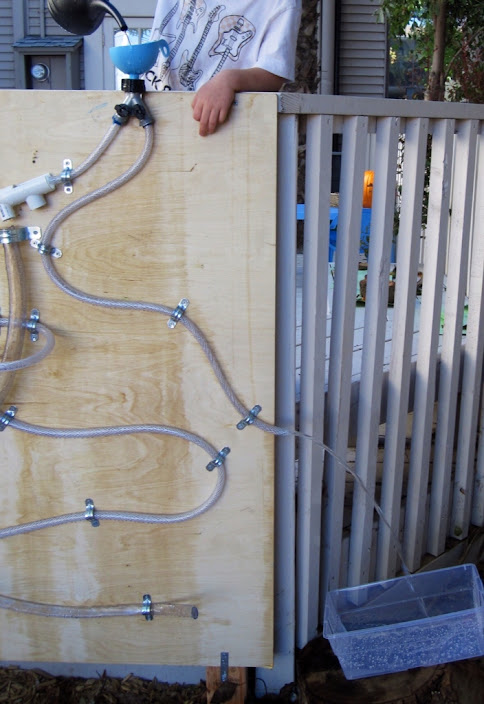
Recently I've been in playground improvement mode. After looking at hundreds of ideas on Pinterest, I came up with a list of things I wanted to try at our school. The project at the top of my list was a water play area where children could pour water into tubes and watch the water flow through and come out the other end. I'm not sure where I got this idea, but it was pretty clear in my mind what I wanted. All I had to do was find the right pieces to make it happen. Since we had a three-day weekend for MLK Day, I enlisted the help of my fiancé, Howard, and we made a trip to Lowes for supplies.

After about two hours at the hardware store, this is what we had.
Howard attached all the tubes to a 4-foot by 4-foot board.
This is what it looked like when it was finished. We hung it on the side of the deck so that some children could stand on the deck to pour the water into the tubes, and other children could stand on the other side to watch the water flow through.
At the top of each set of tubes, we installed a two-way "Y" hose shut-off connector, which the kids could use to open or close each valve. This way, we could have the water flow into both tubes or just one as we wished. Then we put funnels at the top to make pouring a little easier.
The children loved pouring water into the funnels...
And watching it come out!
I put a bucket at the end of each tube so that we could catch and reuse the water.
Playing in the water as it came out was also lots of fun!
At first I was calling this the water board, but Howard pointed out that it might not be a good idea to send the children home saying that they had been "water boarding" all morning :)

Thursday, November 15, 2012

What Will the Ants Eat?

Last week we found a whole bunch of pill bugs under some rocks in our playground, and ever since then the class has been all about bugs. Every time we go outside we turn over all of the rocks to look for bugs, though the bugs seem to have learned their lesson as we never find them under the rocks anymore.
 
Still, we look for bugs outside every day and yesterday we found some ants marching around looking for food. We wondered what kind of food the ants would like to eat and decided to find out. I put together bits of random food that we had in the classroom to make an ant food platter.
Before taking it outside, the children predicted what they thought the ants would eat. Then we took the ant food platter to the spot where the ants were crawling around. We took everything off the plate, except for the honey, and put the food in different spots around the ants.
After watching for a few minutes, the children realized that the ants weren't going to start eating right away, so they went off to do other things. Every few minutes someone would check on the ants to see if they had started eating yet. After about ten minutes one little ant found the apple slice.
Everyone was very excited! As we watched, the ants also found the goldfish and the honey.
We left the food out during nap time and came back to look at it in the afternoon. It turned it that once the ants found the honey, they forgot about the other food and all starting feasting on the delicious, sweet honey.
I printed out a picture of the food we had put out and typed up the predictions the children had made before the activity, and hung both in the science center. I also wrote down the outcome of the experiment. The children kept coming to the center to "read" about the experiment. They were also very excited to show it to their parents later in the day.
 
This experiment made such an impression that the children started talking about it again first thing this morning. So I came up with this art project to go along with the science project.
I made paper cut-outs of the foods we gave to the ants and let the children glue them onto construction paper. Then I gave them black paint and showed them how to make fingerprint ants. It didn't matter that the pictures weren't exactly accurate. What is important is that the class was learning about the scientific process by making predictions, experimenting, and recording their findings!