Showing posts with label Books. Show all posts

Thursday, October 24, 2013

Lots of Pumpkins!

Last week I went to Sprouts Farmers Market to get a couple of pumpkins for our classroom. They were so cheap I ended up getting about twenty pumpkins and gourds in all different sizes and colors. Since then, we have been using them in all areas of the classroom and even in the playground. Here are some of our favorite ways to use pumpkins at preschool.

1. Pumpkin Hammering


We hammered golf tees into one of the bigger pumpkins with the hammers from our work bench. Holding the tee still with one hand while hitting it with the hammer requires concentration and works fine motor skills and hand-eye coordination. 

2. Pumpkin Geo-Boards


This one was my co-teacher, Miss Erin's, idea. Once our pumpkin was full of nails, we stretched rubber bands around the nails to make shapes. 

3. Dry Erase Pumpkin Drawing


We drew faces that could wipe right off with our dry erase markers. 

4. Pumpkin Houses


We drew doors and windows on some of our pumpkins and added them, along with the little people, to the play-dough table.

5. Pumpkin Mummies


One of our class' favorite Halloween books is Skeleton Meets the Mommy. After reading it several times, we used gauze to make our pumpkins look like mummies.

6. Pumpkin Stew


 I saw this wonderful idea on the blog My Nearest and Dearest.


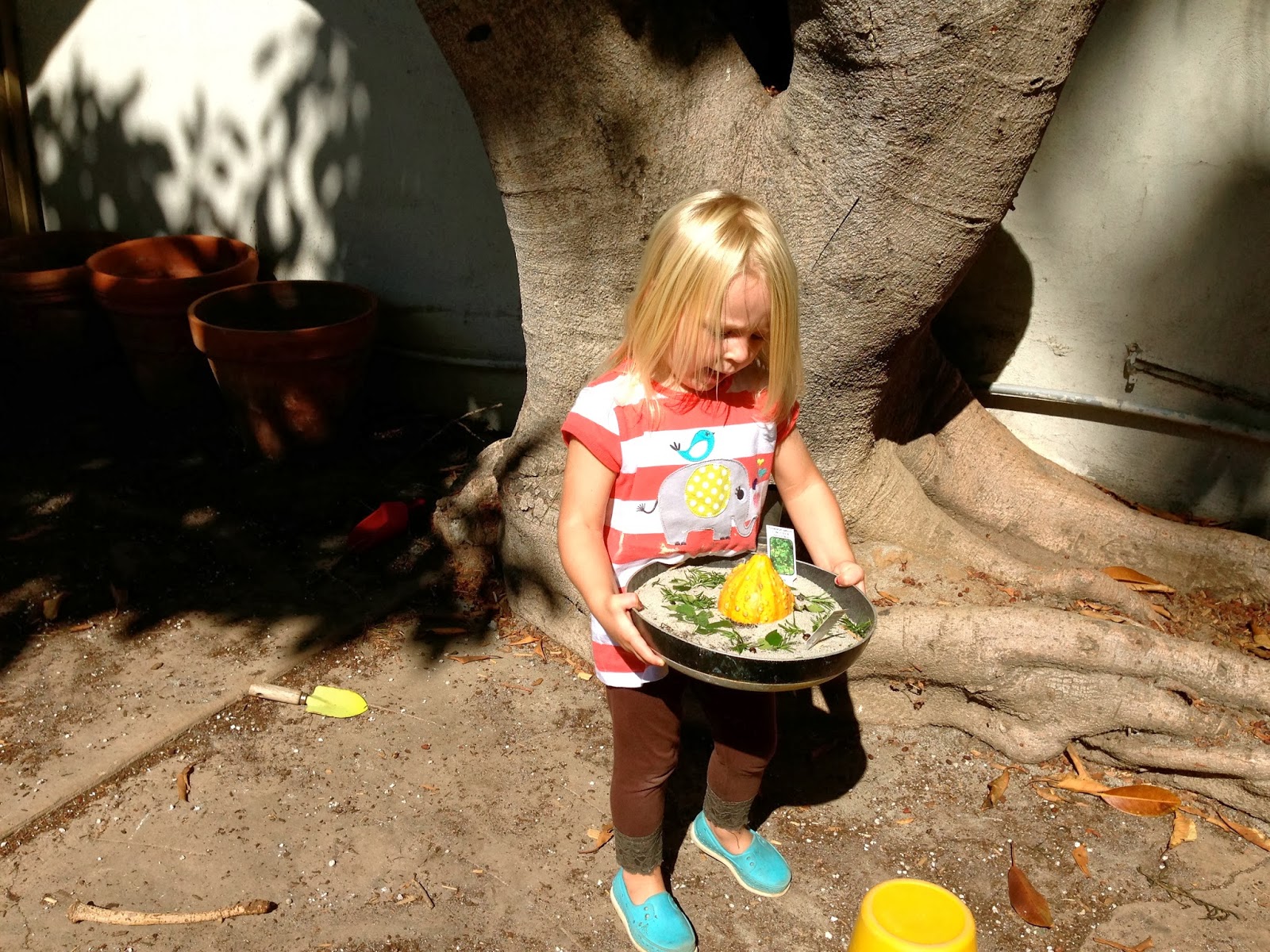
I simply set out the invitation to play and the children cooked up a delicious, pumpkin spice stew!

7. Pumpkin Painting


We dipped pumpkins and gourds in paint and rolled them across a big piece of paper. 

8.Pumpkins in the Playground


Sometimes it's best to just put out the materials and then let the children decide what to do with them. We took the pumpkins outside and added them to the other loose parts in the playground. Here are some of the wonderful and creative things we saw the children doing with them.


Wednesday, January 30, 2013

Gardening in Preschool

One of my favorite children's books about gardening is The Curious Garden by Peter Brown. The illustrations in this book are charming and beautiful. It tells the story of a little boy, Liam, who makes his city prettier by growing trees, flowers, and other plants. My classes have always enjoyed reading The Curious Garden. They especially like comparing the picture of the city before it had gardens to the picture of the city after Liam inspired everyone to grow things.

Since we were about to start beautifying our playground with gardens, it seemed to be the appropriate book to read. After reading it, we set out to plant gardens "just like the boy in the book", as one of our students put it.

Over the weekend, I had taken a trip to the local nursery to get some plants and potting soil. I also found some child-sized gardening tools, children's gardening gloves, and small watering cans. We already had some large terracotta pots that I moved into the outdoor kitchen area. Once we went outside, I let the children shovel dirt into (and out of) the pots for a while before we put the plants in.

The actual planting part didn't seem to interest the children very much, so I did most of it.


They all loved watering the plants, though. At this rate, these flowers and herbs will never be thirsty!

When we were finished, I let the children use the extra potting soil to fill small terra cota pots...

and plant other things.

They also used some of it to "cook" in the kitchen area.

Mud soup! Yum!


Saturday, January 12, 2013

Monster Emotions


 One of my favorite children's books about emotions is Glad Monster, Sad Monster  which we read many times this week. The book came with monster emotion masks for the children to try on.


After reading the book, we decided to make our own monsters using an idea for blown paint monsters that I found on Pinterest. I gave each child a drinking straw and a glob of watered down paint. It took a little practice, but eventually the children were able to blow the paint around on the paper with their straws.

Once the pictures dried, we used googly eyes and markers to make faces on the monsters. Then I asked each child if their monster was glad or sad. 


Our glad and sad monsters made a very colorful classroom display.

Tuesday, October 23, 2012

The Rainbow Fish Printable Game

The Rainbow Fish  by Marcus Pfister is a wonderful book about sharing, and is a staple in many classrooms. Last week, my class wanted to read it over and over. Every time we read it, we talked about how nice the Rainbow Fish was to share with his friends. Every time one of the children shared a toy with a classmate, I said, "You shared like the Rainbow Fish!"

With all this talk about sharing and the Rainbow Fish, I wanted to come up with an activity that would allow the children to practice sharing. This is what I made. 


Besides being a sharing activity, it also allows children to practice their number as they match the scales to the appropriate fish. 


You can download the templates I made for the Rainbow Fish and his friends below.

I colored mine, cut them out, and laminated them. To make the scales sparkly, I just brushed them with glue and and sprinkled some glitter on them. Then I put five pieces of Velcro on the Rainbow Fish.


I also put one on each of his friends and on each scale.  


Then I used permanent marker to write a number on each scale and one on each of Rainbow Fish's friends. I made sure to give him one permanent sparkly scale for himself! Now the children can take the scales off of the Rainbow Fish and share them with all of his friends!


Here's the link to download my fish templates, which you can color and cut out: http://www.aspenleafpreschool.com/wp-content/uploads/2012/10/Fish-templates.pdf


Monday, September 10, 2012

Setting Up the Classrooms

For me, setting up the preschool classrooms was my favorite part of getting the school ready. I was starting from scratch and I was on a mission to create a welcoming, child friendly environment that would promote independence and creativity. I wanted the classrooms to help the children feel safe and comfortable while engaging them and stimulating their curiosity.
The first step was to purchase child sized shelves, tables, and chairs. Having furniture that is the appropriate size for the children who will be using the room, helps them to feel comfortable and gives them a sense of empowerment. Besides this, the small furniture is more practical for children. When a child is sitting in the appropriate sized chair, she is more likely to stay seated during meals and activities because she can sit without dangling legs or other discomfort. The smaller shelves allow teachers to see and monitor all the different areas of the classroom.
Book Corner
I love books so the first area I set up in each classroom was the book corner. The book corner should be an area where children can sit quietly to read and relax. It should be clearly separated from the rest of the classroom by shelves or other furniture. I wanted ours to have lots of natural light so I positioned them near windows. I also wanted the children to have a soft comfortable place to sit so I added an area rug, pillows, and stuffed animals. I framed and added art work that some of my former students had given me to give it a homey touch. In the future, I hope to add some comfy, child-sized chairs.
I had read about using Ikea spice racks for book shelves on another blog. When I went it the Ikea near me, they were it of the spice racks but, fortunately, I came cross these picture ledges that worked just as well.

Dramatic Play Area
When a child plays pretend, he is not only having, he is also learning important skills. Through pretend play a child has the opportunity to take on a new role. He can be a mailman, a race car driver, a parent, or anyone else he chooses to be. When he pretends to be another person, he is learning about the roll that person plays in the community. Children also use this pretend play time to try out new words and language. If you watch a child have a pretend phone conversation or feed a baby doll, you can hear them repeating the things they have heard adults saying. When they play pretend with other children, they are learning to compromise and to get along with other people.
I like to use the dramatic play area as more then just a kitchen area. Throughout the year, I bring in different props for the children to use such as an empty wading pool and swimming gear in the summer, a tree to decorate at Christmas time, or props that have to do with the topic we are covering in the classroom. 

But since we are just starting out, I decided to begin with the basics. I set up our dramatic play area as a kitchen and home area. Since the school building is actually an old house, one room has a closed up fireplace. This seemed to be the perfect, homey place to set up the center. My fiancé found a wonderful, used kitchen play set that had hardly been played with at all. I added a small table and chairs, dishes and food, dolls with changes of clothes, and some dress up clothes.
The dramatic play area in the second room was set up is similar way except it doesn't have a fireplace.
Block Area
Over the past few years, I have been in several schools that did not have large floor blocks for the children to build with. I know that this is partly because blocks are expensive and because they can be loud but the benefits children reap from playing with blocks are worth the money and the noise. When children play with blocks they are learning:
Math concepts such as size, shape, weight, and symmetry
Science concepts including gravity and balance
Hand-eye coordination
Communication skills
Symbolic thought
To be creative
To make connections and to solve problems
To work together
To appreciate and respect other's work
For this reason, I made sure to have a well stocked block area in each classroom. Right now there are also cars and trucks in the block area but we can switch them out later for animals, trains, plastic people, or other props.


Friday, April 13, 2012

Making Vegetable Soup

We have been talking about seeds and planting all week and have planted some seeds of our own. Today, in keeping with this theme, we read the book Growing Vegetable Soup by Lois Ehlert. In the book a child plants vegetable seeds with her dad and, when the seeds have grown into plants, harvests the vegetables and makes soup with them. Our seeds are obviously nowhere near ready to harvest, but we still wanted to make vegetable soup so I brought in some veggies from home. I brought tomatoes, broccoli, cauliflower, and carrots, but any vegetables would work. 
We carefully cut the vegetables into small pieces.
I opened a can of chicken broth and poured it into a bowl. Then the children put their chopped veggies into the broth.  
 We put the soup into the microwave for five minutes. While it cooked we sang songs to pass the time. 
When it was finally done we let it cool a little and then ate it up. 
Everyone loved it and wanted seconds! 

Thursday, March 8, 2012

Trains, Trains, Trains


We have been doing so many train activities over the past week but I haven't had much time to blog so I decided to put five of my favorites in one blog post. 

1. Freight Train
This activity I found at teachpreschool.org. After reading Frieght Train by Donald Crews, we set up this train center on one of our tables. 
I used painters tape to make the track and photo copied a picture of the freght train from the book and taped it to the table. I cut out construction paper rectangles for the train cars and set out a bowl of glass stones that the children put on the bottom of the cars for wheels. Most of the children followed the pattern in the picture when they lined up their train cars. 

2. Shape Trains 
For these trains, I cut lots of shapes out of different colored construction paper. I gave the children glue sticks so that they could create their own trains using the precut shapes. 
We also used painters tape to make a railroad track on the side of our castle and taped the trains onto the track.  
   
3. Cardboard Box Train Cars
 We used shoe boxes and small packing boxes with the top flaps removed for this activity. Each child cut up pieces of construction paper and glued them to their boxes. Our class loves to use scissors so the cutting portion of this activity lasted a long time. We did finally get around to gluing the paper scraps onto the boxes. 
After attaching strings to each box, we tried tying all of the boxes together but the children each wanted their own box. In the end, everyone pulled their own single car train around the room filling it with toys along the way. 

 4. Painter's Tape Train Tracks
We went through a lot of painter's tape this week mainly because of this activity. With the children's help, I put strips of tape on the rug all over the classroom and we drove the toy trains on them. Our track went under chairs, around shelves, and even up the door!

 5. Train Conductor's Hat
I found the directions for making these hats at 4crazykings.blogspot.com. We used construction paper for ours (the children chose their own colors) and we added a band with the child's name across the front. Before cutting and folding the papers, the children colored them with markers.